Posted by: nordicnoir | April 9, 2013

REVIEW: Two Essential Guides to Nordic Noir

Nordic Noir: The Pocket Essential Guide to Scandinavian Crime Fiction, Film & TV

by Barry Forshaw – Pockets Essentials, March 25th 2013

See also the US release – Oldcastle Books, release set for Sept. 1st 2013

Death in a Cold Climate: A Guide to Scandinavian Crime Fiction

by Barry Forshaw – Palgrave Macmillan, 2012

Since the Scandinavian crime fiction bonanza began, there has been a growing need for guidance to help sort through the enormous quantity of material, both for readers and viewers as well as critics, academics and bloggers like myself. Barry Forshaw, a journalist and crime fiction and cinema critic, has just published the second of two guides on the subject. I’m reviewing both together because they have much in common but aim for different audiences. I’ll start with the newer guide since it has just come out.

***

Nordic Noir (2013)

Nordic Noir is directed squarely at the readers and fans of Scandinavian crime fiction and related films and TV series. Material imported from Death in a Cold Climate is either streamlined or in some cases expanded to help point the way to new authors and films. Nordic Noir contains dozens of useful, concise reviews organized under broader topic headings that cover a) the relevant early crime fiction writers such as Sjöwall & Wahlöö b) Henning Mankell’s Wallander novels, along with notes on his many other writings, c) Stieg Larsson, d) a wide array of other Swedish writers e) a chapter on specifically Norwegian authors, f) on Icelandic and Finnish authors, g) on Danish authors, h) on film and TV adaptations, and (i) as an epilogue, mention of many authors on the rise. In addition, one of the most useful features of Nordic Noir, especially for readers new to Scandinavian crime fiction, is an appendix listing the “Top Twenty Nordic Noir Novels,” the “Top Six Nordic Noir Films,” and the “Top Six Nordic Noir TV Dramas.” Like Death in a Cold Climate, it also offers lengthy author statements and interviews. Most memorable perhaps is Forshaw’s account of a meeting with Henning Mankell, who after 40+ novels makes for a seasoned, even formidable respondent. The reader will also enjoy Forshaw’s frank, broad-ranging commentary on everything from fiction to film/TV to real-life crime statistics. Readers looking for a specific kind of novel, type of protagonist, level of action or scenic description will appreciate his clear assessments.

Nordic Noir also includes a fair amount of insight as to what makes this genre—in this particular region of the world—more than usually fascinating to the wider public today. I am talking about the uniquely Scandinavian perspective on politics and society as reflected in crime fiction, a subject dear to the hearts of newspapers, magazines, blogs, and Scandinavian Studies departments around the world. Forshaw’s reviews help clarify which authors put the most or least emphasis on social or political elements and help to contextualize their work and viewpoints. The reader will come away with a greater understanding of just how complex and varied Scandinavian attitudes can be. For instance, Sjöwall & Wahlöö conveyed a Marxist perspective (though one that aims its criticism “at all levels” (14) of society, avoiding pointless oversimplification). Roughly half a century later, Liza Marklund also asserts that the violent world depicted in most Nordic Noir novels is “more correct than our propaganda brochures” (45). Yet Sean French remarks that Sweden is “the most effective welfare state the world [has] ever seen”—while acknowledging that perhaps there is “much murkiness about the Swedish miracle” (79).

While Nordic Noir can be used as a reference book—complete with a comprehensive index—it can also be read straight through as an exploration of Scandinavian culture and its influence on other countries. Common misperceptions are pointed out and less obvious aspects of Scandinavian life are illuminated. I was interested, for instance, to see Toby Haynes (director of one of the Kenneth Branagh Wallander episodes) quoted on the chilling psychological effect of the Cold War and the threat of nuclear annihilation on Swedish citizens. This is something my Swedish husband mentioned to me long ago, and it’s no trivial observation.

In short, Nordic Noir is quite useful to anyone interested in the topic, but especially to those beginning to dig through the avalanche of new Nordic noir titles.

****

Death in a Cold Climate (2012)

While readers like myself will find both guides useful, there is some overlap. Death in a Cold Climate offers the same sort of helpful commentary and reviews, for instance, but the material is not laid out as cleanly for a general reader. Instead, it is geared toward those interested in a fuller examination of the social, political, and literary implications of Scandinavian crime fiction—for this crowd, it’s indispensable.

Forshaw solidly justifies the attention the genre has received in the media. Scandinavian crime fiction, he points out, offers writers and critics alike an unprecedented chance to engage with a large number of readers on a slightly higher level than typical crime fiction. This is partly because Nordic novelists deal in markedly more “opaque motivation and clouded psychology” which “[forces] the reader to make a more crucial engagement with the text than is customary…” (49). He notes too that “the writers of the best Nordic fiction … offer us a greater (and more flexible) range of choices” (50). The choices at issue and discussed at some length are not merely psychological or intellectual, but also political and social. The welfare state as found in Scandinavia is not as familiar to British readers (Forshaw’s primary audience) as they might have guessed. The subtle and not-so-subtle differences between Sweden, Norway, Denmark, Iceland, and Finland also emerge in brief descriptions of each country’s social and political structures as well as their geographical features. Throughout, Forshaw allows ample space to writers, translators, editors, and publishers of crime fiction to share their own thoughts on the state of their nations as well as the state of their craft. Their strikingly disparate viewpoints are enlightening, as you can see in this sampling of snippets cut from longer, more complicated passages in the book:

Mons Kallentoft, novelist: “To be brutally frank, social democracy as an ideal is dead in Scandinavia at the moment. It needs to be redefined…” (47).

Karin Alvtegen, novelist: “Speaking from a political standpoint, the socioeconomic divisions and differences in Sweden have increased considerably since the 1990s…Since 2006, when the centre-right Alliance won the election over the Social Democrats…the disparities have notably increased” (61).

Johan Theorin, novelist: “Sweden is, in general, not a tarnished society and when it’s exposed to the light, Swedish malfeasance tends, let’s face it, to be very trivial—usually some political official with a little power in a commune who has been given a care to seal a building contract or something. Frankly, it doesn’t make for stirring drama” (77). Theorin’s level-headed assessment also includes his comment on the current lack of “immigrant crime fiction writers” — a potentially fascinating new angle.

Dr. Jakob Stougaard-Nielsen, lecturer in Scandinavian literature at University College London: “To claim that crime novels paint an accurate picture of Scandinavia societies would be mistaken—the level of violence and crime obviously doesn’t represent reality; but I suggest that the crime depicted should be taken as symbolic of a sense of growing insecurity not only pertaining to Scandinavia” 164).

Barbara Haviland, translator: “Scandinavian crime writers often seem anxious to make some sort of political or social statement…To be honest I think there’s too much of this, particularly among female crime writers in Scandinavia, many of whom seem to feel that it’s almost obligatory to describe the seemingly appalling social conditions in what are some of the most prosperous democratic countries in the world” (176).

Politics aside, Death in a Cold Climate also offers rare access to the inner workings of the publishing world. Forshaw has been covering Nordic crime fiction for some time now, and few people can have spoken with more authors, agents, editors, publishers, film makers, and academics on the subject. The literary chatter is delightfully wide-ranging. Arnaldur Idriđason comments that “…there really are very few very good crime writers working today” (142). In turn, the author Quentin Bates feels that Idriđason is actually better in translation (thanks to the late Bernard Scudder) (128). Camilla Läckberg’s publisher, Julia Wisdom, shares her strategies to increase publicity (39). Juliet Grames, publisher of The Boy in the Suitcase, describes the recent attention that translated fiction has garnered from the Nordic Noir boom (179). Forshaw comments on the ancient/modern schism in Icelandic authors’ hearts: “Everyone in Iceland seems to be on Facebook, yet everyone’s granny has spoken to elves” (133). Last, I particularly enjoyed the translator Laurie Thompson’s remarks on the precise meaning of the word “skog” (forest, woods, and so much more) (30).

***

As satisfying as Forshaw’s two guides are, some topics perhaps merit deeper discussion, such as the influence of high literary culture (the Icelandic Sagas, Ibsen, Strindberg, Bergman, Söderberg and others) on Nordic noir. One could attend further to Theorin’s observation on the absence of new immigrant authors and the thorny issues surrounding race, religion, and skin color in the Nordic countries. It might be interesting, too, to consider the relative lack of environmental themes in Nordic noir—surprising, given Scandinavians’ progressive environmental values (though one recent exception I’ve found is Antti Tuomainen’s The Healer).

In any case, Forshaw’s Nordic Noir and Death in a Cold Climate allow readers and viewers to enter into the discussion at many different levels, and I am very glad to have read both of them.

Posted by: nordicnoir | November 30, 2012

Music for Nordic Noir 2: Swedish Melancholy

Tomas Andersson-Wij, Lars Winnerbäck, Sophie Zelmani (in English),

Peter Le Marc, and First Aid Kit (in English)

Continuing my “Music for Nordic Noir” series… Today, I’m focusing on five contemporary singers or bands. Most of these songs are in Swedish, though not all. I listened to them a good long while without understanding the lyrics–the music speaks for itself. However, I have described the lyrics and translated a few lines below. The unifying theme here is a noticeable Swedish love of melancholy, which I think may have something to do with the popularity of Nordic Noir in general.

File:Taw wiki.jpgSo, here we go:

Tomas Andersson-Wij’s “Sanningen Om Dig.” I sometimes think this could be one of the quintessential ‘Nordic Noir songs’ I’ve heard. It sounds remarkably similar to U2′s “Love is Blindness” (the last song on Achtung Baby) in terms of melody and voice, yet Andersson-Wij’s song is far less overwrought. Where the U2 song is about love that tends toward violence, Andersson-Wij’s is, I believe, about the loss of a parent–certainly not about detectives or murder. That said, the loss is described in terms vaguely similar to a missing persons case, or even a crime scene. “There are paths you made / which never disappeared, although the snow blanketed them, though the woods burned/ and you heard a cry…The woods keep silent/ but they don’t forget anything…”  It’s not an overt connection, but I recently listened to this while reading Johan Theorin’s Skumtimmen (Echoes from the Dead), which is about a woman whose son disappeared, and now the association is fixed in my head.

Here is a Youtube link to Andersson-Wij in 2008 playing ”Sanningen Om Dig.” There’s a little light chatter in the background, but that’s why you should support the artist and buy his song. The song is not on Spotify currently.

***********

 Lars Winnerbäck has a knack for stringing together dozens of songs that perfectly blend together melancholy, bitterness, love, and weariness. The melodies are beautiful, if often sad. It’s quite difficult to choose just one song, but here are two:

“Mareld” is my favorite. The word itself is interesting. Its literal translation is “seafire” which refers to bioluminescence on the ocean’s surface–fitting since the song ponders the sad, even loathsome superficiality of contemporary life. But the word also calls to mind “mardröm”, or night mare (‘mar’ can come from two different roots). The song begins with a mystery. Something is wrong with the singer, but he can’t explain what. The rhyming lyrics are woven tightly together. He is “gliding” and “losing [his] focus.” In time, he locates his problem in the superficial nature of modern life–the fixation with money, sensational media that just gives people “what they want.” But it’s not only disgust with the mindless masses that troubles the singer, it’s a sense of inner decay: ”I had so many ideas/I had a clear path/I had a thousand questions/and a thousand answers/ Quiet lies the way/in redbrown rust/It’s like seafire on the surface/like ‘all saint’s frost’ “

Anyway, it’s a gorgeous, sad song: Lars Winnerbäck – Mareld (spotify).

A close second is “Elegi.” This is an elegy for a couple’s private, shared sorrows. “An elegy for all the sorrows the fall hands out / for a mother in her sickbed, a child never born / For the shade on the path never warmed by sun / for the strength that failed, you mourn mine, and I mourn yours…” If this sounds incredibly depressing, ultimately this ‘elegy’ is more of a hymn to the couple’s trust in each other.

Lars Winnerbäck – Elegi (spotify)           Here are the translated lyrics: Elegi

************

Sophie Zelmani sings in English. While Zelmani has recorded many albums, she is mostly too shy to sing in public. I find this completely endearing, though I would never have guessed it from my pick for today – “So Long”. This song has a steely, relentless intensity. Hypnotic and rather addictive, it’s a superb song for someone determined not to give up (or embarking on a road trip). My Nordic Noir pairing for Zelmani: Åsa Larsson’s novels, since her heroines are steely and relentless too.

Sophie Zelmani – So Long  (spotify)

***********

Peter LeMarc was born in 1958 in Trollhättan. Yes, in fact, in “troll hat.” To translate loosely from his Swedish Wikipedia page, he grew up listening to the Beatles and the Rolling Stones, and his first album was called “Buick.” His father died of cancer in 1977, when he was just 19; his sadness is a recurring theme in his songs.

In “Between the Moon and My Window” the singer commiserates with others who have known a terrible sorrow. “Between the moon and my window lies a bridge” he sings, and urges the listener to “let the night have its way, all the time it takes / it must rain, so that something can grow…” “I know how it feels, for I have been there,” he says, attempting to console. There is a sense of unbreakable tension in the song, yet the melody finds its way, here and there, to brief moments of peace. In the end, it sounds as though the singer is attempting to console himself as much as anyone else. Kurt Wallander would do well to listen to LeMarc.

 Mellan Månen Och Mitt Fönster    (Between the Moon and My Window) – a decent recording on Youtube

If you like LeMarc’s voice and style, try a few other songs of his on Spotify–many are similar.

************

Last but not least: First Aid Kit. Johanna and Klara Söderberg are sisters, and they also sing in English with “close vocal harmonies and woodsy, folk-influenced songwriting” (-Wikipedia). Their music often uses rolling, dangerous rhythms and minor keys to great effect; there’s also a hint of the wild west. They sing with a very light American “twang”that I find irresistible; they seem to relish this accent in a way only a foreigner could.

The most popular of their songs so far, I think, is “Emmylou,” but it’s only a little ‘noirish’. However, it’s a fabulous piece of pop music–try it out! Two songs that definitely make my list are “The Lion’s Roar” and “Wolf.” Really catchy, haunting tunes; I have cursed them at 3 am more than once because I couldn’t get them out of my head–in a good way, of course!

Spotify: First Aid Kit – The Lion’s Roar

Spotify: First Aid Kit – Wolf

Posted by: nordicnoir | August 29, 2012

New Lead on Olof Palme Assassination?

Eva Rausing’s Death and the Unsolved Mystery of Olof Palme’s Assassination

I once wrote about how the 1986 assassination of Olof Palme had shaped Swedish crime fiction. I later wrote a post on Nordic Noir in a 1970s film in which I briefly mentioned the immensely successful Swedish company, Tetrapak, and the unfortunate death this year of an heiress to the family fortune. Quite surprisingly, the two events are now linked. Sweden’s major newspaper Dagens Nyheter reported on it in a lengthy article (“Eva Rausings mejl om Palmemordet“).

If you’re thinking, “What? Who?” let me give you a totally hypothetical analogy: What if, one day, Donald Trump’s daughter were found dead of an apparent overdose (but with some suspicious circumstances) and then it came out that she had been corresponding with a respected author on the subject of JFK’s assassination, saying she knew the “businessman” responsible for it? –Again, this never happened, but I’m trying to suggest how Swedes might be feeling about the Eva Rausing story right now.

I will translate and/or paraphrase parts of the Dagens Nyheter article here:

The heiress, Eva Rausing, had apparently contacted the “Swedish author and expert on the Palme murder, Gunnar Wall” last year (2011) and told him she knew who the killer was. She wrote, “My name is Eva Rausing and I am married to Hans K. Rausing and I have recently discovered from my husband, with whom I’ve been married for 20 years, that XX was behind the murder of Olof Palme. My husband discovered this by chance many years ago and it affected him very, very badly. I believe that I know where the murder weapon is.”  She maintained Palme was murdered by a businessman for reasons relating to private gain, and that the businessman “believed that Palme was a threat to his company and didn’t want to lose it.” She also said she was afraid of the man: “He is not a good person but I would never say something like this if it weren’t true.” That said, she also told Wall that others were involved, and that she knew where the murder weapon was. “Perhaps…when the time is right, the whole story will come out,” she wrote.

At this point in the DN article, Eva Rausing’s story starts to sound a little more confused and unbalanced. She shared her theory that Palme was “shot in the base of the neck” (despite forensic evidence to the contrary from the autopsy). She admitted she “doesn’t have any concrete proof” and won’t say what weapon was used despite the fact that she “knows where it was left.” She waffled on whether she was “100% certain” or possibly wrong regarding her claims. To top it all off, she mentions she has been having ” ‘visions’ ” ever since she suffered “cardiac arrest on the operating table.” Yet she maintains that her claims about the businessman were obtained “from her own husband: ‘I know that my husband told the truth about XX.’”

Gunnar Wall did not take her claims too seriously at first. But she apparently wrote to him, in English: “Don’t forget to investigate if I should suddenly die! Just joking i hope.” Wall says that “Her claims about the Swedish businessman were however not obviously unreasonable, Palme had some very bitter opponents in the business world.”

Wall has other reasons to be concerned. Despite the fact that, as DN reported, cocaine and amphetamines were found in her system, and that she had been treated for addiction and also had a pacemaker, “the cause of Eva Rausing’s death is still unclear.” Her body was found by police in an “insulation tape sealed room in the couple’s luxury home in Chelsea” –and it was found 57 days after her death.

So there you have it. Naturally, there is ample reason to believe that Eva Rausing’s drug addiction caused her to have all sorts of delusions. The tragic story of Eva and Hans Rausing’s battle against addiction is well known to the public. This Vancouver Sun article describes Eva Rausing’s immense contributions to anti-addiction charities. Yet the couple had grown reclusive of late, and the few published photos of them show a gaunt, disheveled pair. When the story broke that Eva had died and her death had gone unreported, it made headlines, yet it was woefully plausible that she and her husband had gotten high together, she had died and he had been too far gone to do anything about it. He has been convicted of impeding her burial.

Nevertheless, many questions remain. Apparently Rausing’s computer has been confiscated and the matter is being investigated.

UPDATE (posted Sept. 7th, 2012): Hans Kristian Rausing has denied his wife’s claims. See the NY Post. Of course, I sort of assumed he would deny her claims… Also see Andy Lawrence’s post on a new mini-series based on Palme’s murder.

Posted by: nordicnoir | August 23, 2012

Music for Nordic Noir: Some Jazz

Jan Johansson and Monica Zetterlund

Sweden has given me much to love about it. My husband, for one. The misty archipelago seen slantwise from an airplane at 7am. The ample solitude of suburban birch tree forests. The Swedish fika (coffee break) with the most sinful, whipped cream-ful concoctions you can imagine. The narrow cobblestoned streets of Gamla Stan in winter, picnics at Drottningholm, lacquered wooden boats in the Baltic, clean and efficient trains, an introduction to a rational citizenry that supports a nine party political system … Yet on a daily basis, I am most consistently affected by the haunting Scandinavian music my husband pipes into my head, each piece carefully chosen to pique my noirish interest.

It’s not books, but I aim to share it here. I’ll begin with a little jazz…

JAN JOHANSSON

Jan Johansson, 1965; photo by Lennart Håwi via Wikimedia Commons

Jan Johansson (1931-1968) was born in Sweden in Hälsingland, a heavily wooded wilderness. Later he left for university, and Copenhagen, where he met and worked with Stan Getz and Oscar Petiford. A classically trained pianist, Johansson abandoned his studies to devote himself to jazz. In 1962, he moved back to Sweden and settled in Väsby. The Jan Johansson website says it was here that he “began to work with Georg Riedel, Arne Domnerus, Bosse Broberg, Egil Johansen and Rune Gustafsson.” Here too he developed a minimalist modern jazz in a land known for its stone age runestones etched with references to ancient battles, the Norse gods, and family deaths. In Väsby he composed his most famous album, Jazz på Svenska (Jazz in Swedish), a reinterpretation of traditional Swedish folksongs. The style is quite melodic and what I would describe as accessible even to those who normally don’t like jazz.

Dalarna

The track “Visa från Utanmyra,” with Johansson on the piano and Georg Riedel on acoustic bass, is arguably the unofficial national anthem of Sweden. Utanmyra is in Dalarna, and this piece always makes me think of a farmer in the fields at the first nip of fall; the bass is of course a big-antlered elk tired of the weight of its own head; and Johansson’s touch on the piano has the purity of ice cubes falling into an empty glass. It also reminds me of Dalarna of course…the mirror lakes, those red wooden horses, rowan berry trees, and red cottages tucked in among the hills. The rest of the album is similarly enchanting.

Sadly, while on his way to church for a performance, Johansson died in a car crash at the age of 37. To this day he is relatively unknown outside of Sweden. His sons have continued to promote and sell his music, but until recently, CDs could only be obtained in Sweden. With the magic of the internet, however, his audience seems to be growing.

Here are the Spotify links to the Jan Johansson tracks I especially like. You can also google them and see what’s on Youtube or Itunes, or go to the Jan Johansson website.

Jan Johansson – Visa från UtanmyraJan Johansson – Emigrantvisa

Jan Johansson – Brudmarsch efter Larshöga Jonke

Jan Johansson – Leksands skänklåt

Jan Johansson – Visa Från Järna

Jan Johansson – Leksands skänklåt

…I may have to add a music pronunciation page!

MONICA ZETTERLUND

Monica Zetterlund (1937-2005), blond bombshell, singer, and actress, put her own stamp on “Visa från Utanmyra.” You can listen to it here:

Monica Zetterlund -Visa från Utanmyra (via Youtube)

Monica Zetterlund – Wikimedia Commons

Even if you don’t understand the Swedish lyrics, her voice transforms the music from a melancholy pastoral interlude to a piece of subtle of witchery. While listeners are captivated by her voice, the lyrics (by Björn Lindroth) describe a young woman entranced by a man with whom she has a fling. The refrain tells us with mingled regret and satisfaction, ”Then he walked on by; but he walks on by.” She’s glad to have gotten as close as she did, and the change to the present tense lends the brief affair a dash of eternity.Zetterlund’s memorable performances with the likes of Louis Armstrong, Bill Evans, Stan Getz, and of course Jan Johansson, usually exude more jubilance however. A song like “Sakta Vi Gå Genom Stan”  (Slowly We Walk Through the City) is terrific for anyone planning a romantic night on the town, especially Stockholm. Based on the American tune “Walkin’ My Baby Back Home,” the Swedish version is less about two young lovers than it is about the fabulous city they walk through.

Monica Zetterlund - Sakta Vi Gå Genom Stan (from letssingit.com) - this page contains the Swedish lyrics to the song and also a nifty music video with cool (totally unrelated) footage of 1950′s Stockholm.

Also worth mentioning is perhaps her most famous song, with Bill Evans:

Monica Zetterlund – Monicas Vals (Waltz For Debby)

Bubbliness aside, “Vindarna Sucka Uti Skogarna” (“The Winds Sigh in the Woods”) is one of her darker, more mysterious pieces. It’s about what a shepherd sees all alone in the fields at night–moon, rushing water, sheep. Like Jan Johansson then, she adapts a folk theme to her personal style.

Bill Evans Trio – Vindarna Sucka Uti Skogarna (Monica Zetterlund, vocals)

Zetterlund spent the last part of her life suffering from scoliosis, unable to perform. Worse, she died in an accidental apartment fire that may have been started by smoking in bed. Apparently, she called emergency services and pleaded for help, saying, “I don’t want to die this way.” 

Indeed. But, at least she didn’t live that way.

Well, I hope someone out there will go on to enjoy reading Nordic noir while listening to Johansson and/or Zetterlund!

Posted by: nordicnoir | July 13, 2012

Nordic Noir in a 1970s Film

Bo Widerberg’s Man on the Roof :

A Film Adaptation of Sjöwall and Wahlöö’s The Abominable Man

When I think of Swedish film, I think of Ingmar Bergman. Yet for many reasons, it’s tough to connect Bergman to what is called ‘Nordic Noir’ these days–partly because Bergman was more interested in existential (philosophical) crises than in political ones. There’s more to it than that, but I’ll grapple with that issue another time.

For now, I’ll just talk about Bo Widerberg’s 1976 film Man on the Roof (Mannen på Taket). It was an adaptation of Sjöwall and Wahlöö’s The Abominable Man, itself a classic example of Nordic Noir. You can watch the Widerberg film for free on your computer today: Man on the Roof.

I read  the novel (The Abominable Man) in English after I watched the movie, and for once this didn’t ruin the novel for me. The first half of the novel is written in quiet, concise, yet evocative prose, though the second half tends much more toward action and dialogue. Widerberg’s film follows this bifurcated structure pretty closely. While the novel is ‘a good read’ and offers a specific perspective on 1970s Sweden, the film of course packs a powerful visual punch.

My main interest here is in discussing how the film’s visual details reflect Sweden’s social history. Though there are a few scenes that are just great on their own…like this one:
What is between the black curtains?!

It’s hard to see what this is all about, but it WILL freak you out. It occurs very early in the movie…the novel’s description of the scene is nearly as frightening too.

The first half of the film feels a lot like a documentary. You follow the policemen around as they begin to investigate the crime, you see the dreary hospital, the incredibly depressing police station with its chartreuse and turquoise interior decor and harsh fluorescent lighting. I know a lot of 70s color schemes are back ‘in’, but I bet this one isn’t.

The camera glides past all the riffraff the police have to deal with, the irate protesters, the wailing incarcerated, and this guy:
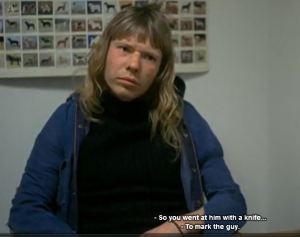
Hairstyles of 1970s Sweden

Yes, this young man is the 1970s image of Swedish social dysfunction.

Widerberg’s movie doesn’t shy away from the gore in the novel…and in fact, the film emphasizes it more than the novel does.

In the film (not in the novel) they are still cleaning up the murder scene halfway through the story. This underscores the awful aftermath of the crime. Not just detectives and forensics units have to deal with this, but everybody–even the janitors who have to mop it all up. The initial horror of the crime transitions into an unbearably tiresome chore.

That weariness, I think, is an essential quality of a lot of Nordic Noir. Not just a sense of melancholy, but the tedious, ongoing nature of crime.

The investigative part of the movie has a slow, methodical pace, but this allows the viewer to engage in time traveling–to see what Sweden really looked like in the 70s.

The detective Martin Beck’s apartment is humble, but also respectable in a very Swedish sense. The exalted Swedish notion of “lagom”–of something being just right, not too much, not too little–is strong here. Note the tidy, plain but functional modern furniture–perhaps bought sensibly from IKEA. Note the taste for small-scale modern art rather than any pandering to a lost aristocratic artistic tradition. Note the prominent set of encyclopedias. A healthy, well-educated family might be raised here (if only the father weren’t beleaguered by a stressful job!).

By contrast, when the detectives visit the suspect’s parents’ home, they are met with the stifling atmosphere of decadence and the shabby tatters of luxury lost.

The house, while free-standing and appealing in shape, is dilapidated. Its front gate doesn’t close properly. The garden is unkempt. Something is wrong here.
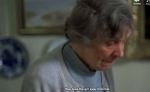
The occupants are an elderly pair of “pensioners” whose decor betrays their economic fall from grace. On the wall are ornate gilt-framed paintings and traditional flow blue china plates. These are people who once had plenty of money to spare, and they seem to like living among the ruins.

As in most Swedish films and books, there is a ‘fika’ scene, i.e. the cherished Swedish tradition of taking a proper coffee break. In this one we see two contrasting Swedish cultures smashed into one little house: the old Sweden, formal, class conscious,  and luxurious (for a few), and the new Sweden which promotes both social equality and entrepreneurial innovation.

For instance, Widerberg’s camera focuses on the jarring juxtaposition of a silver creamer as it’s filled (not by a servant!) with Tetra Pak cream–Tetra Pak being one of the most successful business ideas ever to come out of Sweden, and a symbol of vast modern wealth [and just now, family tragedy since once of the heirs was just arrested and his wife found dead]. Tetra Pak cardboard cartons were invented in 1953 by Ruben Rausing. The company was so successful that, as the Guardian puts it, even today, “If you’re an average human, you will use 23 Tetra Paks this year.” This new extraordinary wealth may have been democratically achieved, but the film implies that it’s not clear how it benefits ordinary Swedish people–much less those whose inherited family wealth was taxed away years before.

The elderly couple may seem genteel, even sweet. But they are also clueless; the more they cling to their crumbling past, the more pathetic they are. Their taste is hopelessly outdated. Widerberg lingers, for instance, on a hideous crystal bowl set out with god knows what demented sense of finery, filled with rumpled blue ribbon instead of actual food. What sort of child would these people have raised?

In the midst of Sweden’s great social experiment, then, unintended consequences bubble to the surface (as they always do) and the understaffed police force is left to pick up the pieces, if they can.

The novel portrays this couple using slightly different details, although the same ideas are present. In any case, I was more impressed by the film’s clever visual translation of the scene. The novel’s form, however, allows for certain narrative freedoms. Characters engage in brief interior monologues, which help flesh them out a little. The written Martin Beck ponders his vague but unrelenting sense of guilt in relation to the murderer–i.e., that he’s part of the police system that created the monster now plaguing the city. He knows the police force is underfunded and overburdened; so in that sense, part of the blame falls on the government too. The filmed Martin Beck, by contrast, expresses less overt collective guilt; instead, we only get a general sense of fatigue.

For this reason, I think some people who are allergic to social commentary may find the film more entertaining. But the book is far from heavy-handed; indeed, one of its draws for the general crime fiction reader is its deft pacing.

I don’t want to spoil the plot, but I can say that the last third of the movie (like the novel) has a pretty exciting action sequence in downtown Stockholm. Widerberg admired the chase scenes in the French Connection and it really shows here.

Last: the film’s musical soundtrack. When bullets fly, the film’s otherwise documentary style suddenly trembles with a frenetic, exotic flute music. The music is unexpected and seems strikingly out-of-place in placid, orderly, Nordic Stockholm…in otherwords, it corresponds perfectly to the jarring, bloody events of the day. In the midst of mayhem, a character even wonders, “Am I in India?” This intriguing musical score (by Björn J:son Lindh )  is probably the main reason I began to take this otherwise ordinary “action-thriller” more seriously.

In terms of my series on the “origins of Nordic Noir,” this is more a case of reciprocity between books and film than a case of simple cause and effect. The book came out first, but since many people come to Sjöwall and Wahlöö ‘s book after seeing this film, the film should be understood as a 1970s inspiration for later writers and filmmakers.

In sum, I recommend the movie to anyone interested in Nordic Noir, as long as you don’t mind subtitles, you appreciate historical footage of Stockholm from forty years ago, and you are more amused than distracted by the distinctly Swedish 70s menswear.

Posted by: nordicnoir | April 17, 2012

The First Nordic Noir Novel…from 1905?

In my earlier posts on the Origins of Nordic Noir, I wrote about the moment when Swedes first became entranced by the work of detectives after the assassination of their prime minister in 1986. I’ve done a post on the circuitous road to the social welfare state with some thoughts on how it possibly informed Scandinavian authors. One of the more popular posts so far is on Scandinavian Nazism . Now, I’ll push the timeline back even further—to the year 1905, when Hjalmar Söderberg (1869-1941) published arguably the first Nordic noir novel: Doctor Glas.

The Origins of Nordic Noir IV: Hjalmar Söderberg’s Doctor Glas (1905) *, **

This turn of the century Swedish novel sounds as current, direct, and compelling as any literary crime fiction best seller on the market today. Sexual intrigue, the use and abuse of medical knowledge, methodical planning of a murder, a strange and troubled past…it really is all there in just a brief 150 pages. The novel packs an intense literary and intellectual punch, but I think it’s nonetheless a “page-turner.”

Without giving away the middle or end of the plot, I’ll summarize the set up: Doctor Glas is a genteel bachelor with a successful family medical practice in Stockholm. He is unmarried due to a deep-seated malaise at the human condition and a persistent sense of social alienation. In a series of brutally honest, self-probing diary entries (which make up the entire novel), he ponders his unusual situation and the revulsion he feels, at least superficially, toward the sexual instinct. It is 1905, and he seems to struggle with the way modern science, evolution, and consequent moral uncertainty have cast a dark shadow over notions of love and spiritual union. Educated people in this period, and perhaps particularly doctors, were all but forced to think of sex as a nearly mechanical, sometimes savage biological process. Yet it was also a time when marriage endowed men with irrefutable conjugal “rights” over their wives’ bodies, something that disturbs the doctor—mainly because he finds sex repugnant.

Rights. I passed my hand over my forehead…God in heaven, what has happened to people’s brains, that they should have made rights and duties out of it![1]

A Swedish woman ca. 1900. All rights reserved for photo.

One day, an attractive woman comes into his office, and after some hesitation she unburdens herself to him. She says she made a mistake as a young girl while under the powerful influence of her devoutly religious parents. In a fit of guilty sexual repression, she married an elderly Vicar, unaware of the physical burdens she would face. Years have gone by, and no child has been conceived. Yet the Vicar continues to sleep with her, saying that only God should decide whether or not they will have children. But now the woman has fallen passionately in love with another, younger man. Knowing the joy of true love, she can no longer bear the Vicar’s hideous visitations. Doctor Glas sympathizes entirely.

And here is where the story turns into “noir.” The woman asks him to lie for her, and tell the Vicar that if he sleeps with her anymore it will cause her irreparable physical harm. Doctor Glas agrees to the plan, glad to exercise the power of his medical knowledge to free a pitiful human from further suffering.

At about the same time, though, he develops a complicated attraction to the young woman himself.

…only now, for the first time, did I really see her. For the first time I saw a woman was standing in my room, a woman whose heart was full of desire and misery, in the flower of her womanhood, perfumed with love, yet blushing with shame that this perfume should be so strong and noticeable. I myself turn[ed] pale.[2]

A Swedish boy, ca. 1900. All rights reserved for photo.

Things do not go quite as planned, and the woman remains in distress. Soon enough, the Doctor begins to ask himself, can he do something more for her? After all, he is a doctor, with privileged knowledge of medications and diseases. He also knows the Vicar is worried about his heart….

My examination frightened him a bit…But now I had him on my sofa. And I wasn’t letting him slip away…

–Is it serious? He asked, at length.

I did not answer immediately…[3]

Doctor Glas is a psychological thriller about a man obsessively pondering a terrible crime–or perhaps a not so terrible crime. His uncertainty about the moral implications of the act is all part of the drama. ”Glas” means “glass,” perhaps transparent or invisible, a transmitter of light, terribly hard, but also fragile. As he slowly warms to the idea of committing the crime, casually mingling with the unwitting people involved, he attempts to justify it to himself. But he also betrays his doubts, growing more desperate and sharing more of his own troubled childhood with the reader.

File:Jansson3.jpg

Eugène Jansson (1862-1915) Sunrise over the rooftops. Wikimedia Commons image, from the National Museum, Stockholm.

The dark, brooding narrative is enhanced by the setting: Stockholm near Midsummer’s Eve with the strange, relentless summer light of the far north exacerbating the Doctor’s insomnia. When he can’t sleep, he writes:

Midsummer Eve. Light, blue night. From childhood and youth do I not remember you as the lightest, giddiest, airiest of all nights of the year. Why, then, are you now so oppressive, anxious?[4]

I don’t think readers today will feel overwhelmed by any florid 19th century mannerisms. This is partly because the doctor is not—does not feel himself to be—a man of his time. He increasingly stands apart from the cultural ambitions and affectations of society, feeling at times superior for his scientific knowledge, and at other times deeply uneasy and perplexed by his social dislocation. If I may make one admittedly strained comparison, he is sort of like a super-literate, highly articulate Lisbeth Salander. He does not feel as everyone else feels–not quite. But further, like Lisbeth, he sees an unjust world and feels compelled to right a perceived wrong, rules be damned. He relies on his very own unique moral compass to guide his way. In this, he is a kind of hero…yet as with all the best first person narrative novels, the reader is left wondering how far this hero can be trusted—how well he knows himself, and how much he is willing to admit.

A Swedish woman ca. 1900, possibly a widow in mourning. All rights reserved for photo.

In terms of the crime fiction genre, you could say Doctor Glas presents the “criminal,” not the detective, as the character privileged with a sense of investigative duty. The Doctor perceives a critical truth that seems to elude everyone around him, and he feels compelled to act on it. But for all that, he cannot quite see the full meaning of that act, nor guess at its final consequences.

There is tremendous historical interest in the way Doctor Glas grapples with the newly unshakeable scientific truth of evolution, with the Nietzschean blow to religious authority and spirituality, with turn of the century sexuality and marital relations, and even with euthanasia and eugenics.

But this is also just a sweaty-palmed tale of a daring crime committed to halt another sort of crime, and the resultant aftermath of anxiety and dashed hopes.

*pronunciation of Hjalmar Söderberg :    yahl’ mar   sudd” er ber(ye)’  –the ‘ye’ is pronounced like a single consonant; i.e., ’berg’ is one syllable.

**This post refers to the reissue of Paul Britten Austin’s phenomenal translation of Doktor Glas from 1963  (Anchor Books, 2002). I have not read the novel in Swedish, but it’s one of those translations that makes me shiver to think how incredible the original Swedish version must be. The 2002 edition also features a brilliant introduction by Margaret Atwood.


UPDATE JUNE 11 2012: I just came across Nils Nordberg on Nordic Noir, Circa 2005 at crimetime.co.uk . This is a very lengthy piece on the origins of Nordic Noir with a Norwegian slant. I have now added The Murder of Engineer Roolfsen (1839) by Mauritz Christopher Hansen (1794–1842) to my must-read list.


[1] Söderberg, Hjalmar, Doctor Glas  (Anchor Books, 2002), p. 23.

[2] Ibid., p. 25.

[3] Ibid., p. 50.

[4] Ibid., p. 28.

[5] Ibid., p. 46.

Posted by: nordicnoir | December 29, 2011

Pronunciation Page Updated

It must be clear that for some time this blog was inactive. I apologize to those who emailed or commented and received no reply. I am in the process of sorting through it all now. Judging from the stats, I can’t continue to ignore the blog any longer! So I am planning a few new longer posts now. For the time being, I have updated the pronunciation page. Thanks to one very curious reader, I decided to add the following names:

Björck

Ekström

Fälldin

Fröken

Härnösand

Nieminen

Niedermann

Pontonjärgatan

Södertälje

Thorbjörn

Ulfskog

Wadensjöö

Happy reading to all! -nn

Posted by: nordicnoir | June 22, 2010

Nordic Noir and the Scandinavian Population Crisis

The Origins of Nordic Noir Part III:

Nordic Noir and the Scandinavian Population Crisis

***

Spoiler Alerts:

Major plot elements of Stieg Larsson’s novels and Arnaldur Idridason’s

Jar City are discussed here, as well as a brief mention of a

minor plot element from Yrsa Sigurdardóttir’s Last Rituals.

***

The Mystery… 

            In 1982, Alva Myrdal (1902-1986) won the Nobel Peace Prize for her work on nuclear disarmament.  This followed on a long, successful career as a leading politician whose work included the development of Swedish welfare policies that promoted the well-being of families and working women.

            Also in 1982 her son, Jan Myrdal, released a scathing autobiographical ‘novel’ (Barndom, or Childhood) detailing awful upbringing.[1]

            Alva Myrdal’s name was further tarnished in 1997 when the journalist Maciej Zaremba exposed the darkness at the core of her book from 1934 Kris i befolkningsfrågan (Crisis in the Population Question)—which she co-authored with her husband.[2]  It is widely recognized as the founding document of the Swedish welfare state.

            So what was it about Alva Myrdal?

…The History

            Rightly or wrongly, she was accused of having been an unaffectionate, largely absent mother who sacrificed her children’s well-being even as she pursued her ambitious career campaigning for the benefit of families and working mothers.  But there is another story here too—one I think relates to ‘Nordic noir’ and Sweden’s darkest fears about its dwindling population in the 1930’s and ‘40’s. 

            By way of angling into this thorny issue, read the following excerpt from an interview with a woman who experienced the downside of the Myrdals’ social engineering philosophy—which contained recommendations (that became laws) for dealing with Sweden’s population problem. 

         And try, if you can, not to think of Stieg Larsson’s character Lisbeth Salander here.

Astrid is the daughter of an alcoholic shoemaker who did not take care of his children.  Her mother had died when Astrid was three years old.  A maternal aunt took Astrid and her siblings to presumptive foster parents…[The situation failed] and this led to a transfer to a new foster family where conditions were even worse.  Another foster child enticed Astrid into stealing, and the authorities placed the ten-year-old girl in a private school home for feeble-minded girls…[She received no affection there.] Astrid responded to that by becoming ‘mean.’  One summer when she was 19…she fled. Lonely in the big city of Stockholm after having seen only the walls of an asylum for so many years, she did not know what to do.  Two men brought her home and let her sleep at their place ‘but they didn’t do anything to me!’ After that night she returned to the asylum where the matron accused Astrid of having been sexually exploited.  They wanted to have her sterilized and sent her to a doctor who persuaded her to sign an application to be sterilized.  She was told that she could leave the asylum if she was sterilized…The matron gave Astrid three oranges and paid for a taxi to take her to the hospital….She remembers this time only in fragments, but she found it so terrifying that she has refused ever since to go to a gynaecologist…’ [At the hospital] she ‘became hysterical.’… ‘they probably calmed me down with some tranquilizer…It was like that in those days—if it became too noisy they could just give you an injection.’ [3]

            More than 60,000 sterilizations were performed in Sweden between 1935 and 1975.  More than 20,000 were, in some sense, ‘forced’ (coerced with the promise of freedom from an asylum etc.).[4] Ekerwald quotes one of the more damaging parts of the Myrdals’ book as follows:

In those cases where legal competence cannot be denied…doctors and social authorities ought actively to persuade the person …to be subjected to voluntary sterilization.  If it turns out that such pressure is ineffective…then a sharpening of the law ought to be considered, giving the authorities of the society the right to sterilize even against their will persons with legal competence. (Crisis, p. 260).[5]

            While even today, castration is a legal option in the case of sex-offenders, Sweden’s former sterilization policy registers today as heavy-handed, unjust, and cruel.

The Myrdals’ Reasoning: A Dwindling Population

            The funny thing about the Myrdals’ endorsement of voluntary and involuntary sterilization is that it arose in the 1930’s, when it was clear that Sweden’s population was shrinking.  It seems counterintuitive. 

         Indeed, the other welfare programs laid out by the Myrdals (and particularly the reforms that Alva endorsed on behalf of working women) aimed to encourage Swedes to have more children.  Being generally educated and savvy about the use of contraceptives, Swedes in the early 20th century rightly saw that larger families were correspondingly poorer—often miserably so.  Having few (or no) children in this newly industrialized society meant a far better standard of living, better health, and greater happiness. 

           But officials foresaw an aging population and all the problems associated with a diminishing workforce. To encourage births, Alva Myrdal sought to make child rearing more attractive.  Swedish women, she proposed, would need better health care, adequate maternity leave, safeguards against job loss due to childbearing, education for the children, day care…etc. 

            But these reforms were expensive, and they led to thinking about the sort of people the welfare state could and could not afford to support. 

Who’s In, and Who’s Out

            The Myrdals’ philosophy from the 1930’s and early ‘40’s generally targeted ‘feeble minded’ individuals in order to stave off the financial burden of caring for ‘inferior’ citizens.  But these inferior citizens were not only the mentally handicapped. As Spektorowki and Misrachi note, “In practice, individuals who were targeted for sterilization displayed various forms of social misbehavior, and were therefore marked by the state as unable to take care of their children.”[6]

           Thus, it included alcoholics and vagabonds (gypsies) and anyone else deemed ‘asocial’. In practice though, the target group was mainly (90%) women: “Liberated sexual behavior, untidiness or sloppiness and negligent childcare were all attributed primarily to women.”[7] If the welfare state was to succeed (and if, then, Sweden’s population ceased to decline), the Myrdals thought, it would have to weed out those who might weigh down society. 

             But the Myrdals were not proponents of racial hygiene in the same manner as the German Nazis.[8]  Ekerwald quotes an important passage from the Myrdals’ book in which they distinguish between their own social programs and that of Germany’s “unreliable, speculatively biological, cheap and shallow ‘wisdom’ in social questions.”[9]  The Myrdals also denounced the notorious academics in Uppsala who sought to keep Jews out of Sweden during the ‘30’s. 

            This 40 year policy went largely unnoticed until 1997, likely because the so-called ‘feeble-minded’ felt embarrassed or ashamed.[10]  I also suspect they suffered an utter loss of faith in any and all authorities.

Astrid…the Inspiration for Lisbeth Salander’s Past?

          I hinted above that I saw some connection between Astrid’s memories of forced sterilization and the fictional case of Larsson’s Lisbeth Salander.  Hear me out…

1. Lisbeth Salander is the daughter of a prostitute married to a domestic brute

2. Her mother is maimed and subsequently absent from her life

(3). She attempts to kill her father (a wholly unique plot feature, yes)…

4. …and consequently she is hastily labeled non compis mentis (feeble-minded)

5. She is forcibly removed to an asylum…

6. …where she has terrifying experiences with doctors (namely Dr. Teleborian)

7. She is placed in foster care, but flees

8. She is even accused of hanging out with strange, older men

9. The authorities pretty much ‘accuse’ her of ‘having been sexually exploited,’ though this is far from certain[11]

10. Eventually, she proves she has her wits

           In short, the story of Lisbeth Salander, like Astrid’s, is about the terrifying power of the state to deprive an individual of one’s most basic rights.

           The debate surrounding Swedish forced sterilization often turns to whether or not the welfare state inherently leads to such abuses of individual rights.[12]  Yet forced sterilization has occurred in the U.S., Canada, Japan, China, Switzerland…the list could go on.[13]  And though Larsson’s books seem inspired by this issue, in The Girl Who Kicked the Hornets’ Nest the court trial is a symbol of a democratic judicial system doing its work (if barely).[14] 

The Peculiar ‘Noir’ of Dwindling Populations:

Arnaldur Indridason’s Jar City…

            The Scandinavian population crisis and government attempts to manage its dwindling ‘human capital’ shows up as well, for instance, in Jar City by Arnaldur Indridason.  This novel touches on the Icelandic government’s attempt (and that of medical science in general) to study and codify the country’s uniquely small, isolated genetic history (having only about 320,000 people).  While these activities might help screen out devastating inherited diseases, Indridason suggests they can also subject the citizenry to a degrading, dehumanizing scrutiny.

            The doctors involved are portrayed as cold, even robotic. One doctor—clearly meant to be of dubious character—speaks in passing of his lack of desire to have children; it seems this fact is shorthand for ‘self-centered.’ Further, when the inspector’s own daughter, a cruel and petty drug addict, becomes pregnant, Indridason clearly evokes sympathy with the daughter’s life-affirming choice to keep the baby.  Though abortion is broadly legalized in Iceland, little mention is made of possible birth defects (one can almost hear the young Alva Myrdal groan here).

            Similarly, two rape victims in this novel choose to keep their resultant babies.  When Inspector Erlendur, interviews one woman’s sister, he asks how her sister (the rape victim) reacted.  She responds succinctly: “Very sensibly, I thought.  She decided straightaway to be happy about the child despite the circumstances, and she genuinely loved Audur” (p. 64).  Another rape victim also keeps her baby and raises a beloved son, though in her case she wanted to keep the rape secret from her husband. 

            Yet Indridason adds a few tragic twists to these stories. In both cases, despite these supposedly life-affirming choices, everything ends badly.  The rapist had carried a rare genetic disease that was passed on to the two children.  One dies, the other passes it to his own daughter, who also dies.  He later kills himself. 

            So the novel at once portrays a deep longing to preserve and nourish (Icelandic) life at all costs while also struggling with some troubling consequences.  On the whole, Indridason hints that the Icelandic gene pool is just too small for its own good.

…and a Minor Scene in Yrsa Sigurdardóttir’s Last Rituals


            Sometimes, the population crisis may lurk in the background. Yrsa Sigurdardóttir’s Last Rituals contains a minor scene in which a 15-year-old boy has gotten his 15-year-old girlfriend pregnant.  Though all the parents are horrified and disappointed in their exceedingly young children for making a ‘mistake,’ abortion never once comes up as an option, despite the fact that abortion is broadly legalized in Iceland.  Sigurdardóttir’s quietly pro-life stance here can hardly be unaffected by the cultural implications of Iceland’s tiny population.

Conclusion

            This feature of ‘Nordic noir’ doesn’t only relate to the claustrophobia of living in a small country, of knowing everyone in your small town; nor is it merely about the melancholy expanse of an under-populated countryside.  It also has to do with the rather bleak notion of possible cultural extinction, and the attempt by state and individual, for better and for worse, to do something about it.


[1] Her daughters also published memoirs after her death; Kaj Fölster and Sisela Bok presented more positive views of their childhood, but their work still indicates a troubled family history.

[2] While her husband was widely perceived as an egomaniacal ‘genius’ (also blamed for their children’s poor upbringing) the most troublesome views regarding sterilization are mainly attributed to Alva.

[3] Astrid’s story was told on Swedish radio journalist Bosse Lindquist in the 1980’s.  The transcribed excerpt that I’ve laid out here comes from Hedvig Ekerwald’s “The Modernist Manifesto of Alva and Gunnar Myrdal: Modernization of Sweden in the Thirties and the Question of Sterilization,” International Journal of Politics, Culture, and Society, Vol. 14, No. 3 (Spring, 2001), pp. 539-561.  See especially pp. 539-40.  The bracketed comments in the excerpt are mine.

[4] See p. 541 in Ekerwald.

[5] This quote is taken from Ekerwald p. 546.

[6] Alberto Spektorowski and Elisabet Misrachi. “Eugenics and the Welfare State in Sweden: The Politics of Social Margins and the Idea of a Productive Society.”  Journal of Contemporary History, V. 39, no. 3 (Jul, 2004), pp. 333-352.  See p. 348.

[7] Spektorowki and Misrachi, p. 349 (drawing on the work of historian Maija Runcis).

[8] The precise relation between Swedish sterilization laws and German eugenics remains a contentious issue.  But Spektorowki and Misrachi say, defending Sweden, that “…the Nazis worked to preserve a racial community, whereas the Swedish social democrats aimed at a productive welfare community” (p. 351).

[9] Ekerwald p. 547 (Ekerwald quotes from Crisis in the Population Question p. 87-8).

[10] Ekerwald notes this shame on p. 539.

[11] Most of these details are found on pp. 173-76 of The Girl with the Dragon Tattoo (American edition: Vintage, New York).

[12] Maciej Zaremba maintains that forced sterilization, in Sweden, was a direct result of the project of the welfare state—turning the issue into a direct attack on social democracy.  I take it more as a potential threat to any population under any form of government (since it has clearly happened under many forms of government), though the Swedish welfare state certainly put its peculiar stamp on this instance of it.

[13] For more info, start with Wikipedia: http://en.wikipedia.org/wiki/Compulsory_sterilization

[14] However, unlike the more straightforward case of Astrid, Lisbeth Salander gets away with the theft of millions of dollars.  One wonders (among other things) whether she would have relinquished that money in subsequent novels.

Posted by: nordicnoir | May 31, 2010

The Girl Who Wasn’t a Girl

The Girl Who Wasn’t a Girl


Spoiler Alert: I discuss some minor plot elements

of Stieg Larsson’s novels in the following post.

            At some point (rather soon) I want to look into the representation of women in Scandinavian crime fiction to determine whether or not feminist social reforms have had a significant effect on the development of ‘Nordic noir.’ But for now, I can’t resist another Stieg Larsson centered post—and in a way, it will set up the ‘women in noir’ theme precisely because Larsson’s remarkable heroine is so unlike most female characters in the genre. 

***

            Since the revelation that Stieg Larsson witnessed the gang rape of a girl when he was a young teenager and found himself unable to intervene, a lot has been said about his feminism.  In particular, many have accused Larsson of blatant voyeurism–of merely pretending to be a feminist while indulging in sadistic fantasies.  For me, this particular criticism oversimplifies the matter.  After all, cruel and gory fantasies have been a part of storytelling at least since the Greeks.  What matters is the context of those fantasies and any overriding message—which I think is discernible in Larsson’s work.  Feminism abounds here…but the Millennium books (which after all are only the first of a planned ten novels) also use the character of Lisbeth Salander to point the way beyond feminism.

Larsson’s Women in General

               In general, Larsson’s women are tough; they ‘kick ass’ in bloody brawls, and they are security officers and boxers.  Throughout The Girl who Kicked the Hornets’ Nest—he sprinkles historical interludes about female warriors, from Boudicca to the Amazons.  Further, these women read—not romance novels, but books about math and ancient religion.  They write and hold editorships and are lawyers and detectives.

He also defends women’s—and men’s—sexual freedom to a great degree, without ignoring the complicated reactions they may have to their chosen entanglements.  It seems like women everywhere jump into bed with Blomkvist with no regrets; but by the end of –Hornets’ Nest, things are getting complicated in a more realistic way (thankfully!).

Lisbeth Salander

                Yet even setting aside concerns about the voyeuristic aspects of Larsson’s novels (the detailed rape scenes etc.), I find myself confused about Lisbeth Salander herself.  I think it’s because this ‘heroine’ is about as far from being a typical woman as she can get.  I am not talking about her bi-sexuality, but rather her lack of emotion—that human feature so often associated (rightly or wrongly) with femininity.  True, at the end of the first novel Salander experiences a wave of romantic jealousy when she sees Blomkvist with Erika Berger.  And I admit, I was intrigued by the idea of a character with Asperger’s slowly learning to feel the way most people do.  But I also felt a slight sense of loss.  Oh no, I thought, she’s going to become normal.

But that didn’t last.  Soon enough, she pushed him out of her mind.

Then, the breast implants.  Her plastic surgery seems to indicate her own feeling that she is not ‘woman’ enough.  But it also shows, more importantly, that she views herself as a construct to manipulate. [1]  She can make herself either more or less feminine as she sees fit.  It’s not a sign of ‘low self-esteem’; it’s a sign of calculated control over her own body.   And besides, the implants wind up being a relatively unimportant feature of her personality because she’s so nonchalant about it.  I can’t recall any mention of them in the third novel.

Is Lisbeth Salander a Feminist Character?…

            But I’m particularly bothered (or intrigued) by the action sequences.  As far as kicking ass goes, Salander does it not like a man, still less like a woman—but more like a robot.  In a fabulous fight scene in –Hornets’ Nest, in which Salander is all alone, locked up with a brutal killer with no weapons of her own, she never seems to experience fear, panic, or helplessness.

                   Salander took an appraising look around. Click….

                   No weapons.  

                   Only tools. Click. Her eyes fell on the circular saw…Click. Click.  She saw an iron rod…

I don’t currently have access to the Swedish text here, so I don’t know if the ‘click-clicking’ is Larsson’s doing or Reg Keeland’s, but the point is that she’s got a hard drive for a brain, which is in any case a favorite theme throughout all three novels.  It is Salander’s primary social defect, and her greatest asset.  When she’s in a bind, she doesn’t feel, she computes.  It’s what makes her a kind of superhero.

For a time, I felt this was an indirect criticism of women’s supposed emotional sensitivity—as if to say, if you want to kick ass, ladies, think like a man.  But I was wrong. Larsson actually goes out of his way to show that even regular, non-Asperger’s women can beat up men.  Take Mimi for instance, fighting alongside Paolo Roberto.  Or the Säpo agent Figuerola, or the Milton Security body-guard Susanne Linder.  And they don’t do it by means of feminine cunning. They’re fit and well-trained and professionally driven.  They use their fists.

Nevertheless, in the end, the ‘girl’ to whom readers are most drawn is the one who transcends gender—not so much by transcending fear, but by simply failing to experience that most basic human emotion.[1]  As a superhero, she is a little inhuman, or superhuman–and thus hard to describe truly as a ‘woman’.  Ironically then, despite the strong feminist ideology in Larsson’s novels, it’s hard for me to grant the feminist title to the eponymous ‘girl’ herself.

…Or is she a Cyborg?

            But is this perhaps what Larsson intended?  We may never know where he was going with this character, and yet I find myself wondering if Larsson, in the spirit of Donna Haraway, was actually trying to push beyond our outmoded notions of feminism (and of ‘women’)–into something more expansive and useful for the cyber age.  Haraway’s work (I’m thinking mainly of ‘A Cyborg Manifesto’ [2]) sparkles with imagination and intellectual brilliance far more than the usual academic fare and I highly recommend it (though readers be warned: it is tough reading).  She is also by now quite well-known; it’s possible Larsson knew of her work too.

In a nutshell, Haraway uses astounding scientific and technological breakthroughs as well as purely speculative images from science fiction to forcibly pry apart and shatter stubborn dualist conceptions of reality (man/woman, organism/machine, nature/culture) in favor of hybrid realities.  She describes a ‘cyborg’ as “a cybernetic organism, a hybrid of machine and organism, a creature of social reality as well as a creature of fiction,” and points out how the organism/machine distinction is in fact eroding before our eyes (I note Craig Venter’s very recent development of ‘synthetic life’).  She further says, “The cyborg is a matter of fiction and lived experience that changes what counts as women’s experience in the late twentieth century.”  In short: “The cyborg is a creature in a post-gender world“  (emphasis mine).

Lisbeth Salander’s boob job and computer-brain seem a lot more important in this light.

Haraway certainly uses the cyborg image to think up “a world without gender”, but actually the stakes are far greater than just feminist (or post-feminist) politics.  The ability to think of reality in an entirely new way–unimpeded by oversimplified dichotomies like man/woman or even left/right–may be the key to one day developing a better, more just, as-yet-unimagined society.  And this may be the reason why Larsson paints the Swedish government in a less than positive light, despite its best intentions.  There is always room for improvement, always the threat of corruption, and always a need for greater imagination.

While we will likely never know where Larsson was taking Salander as a character, I believe there is enough evidence that he too was committed to exploding stereotypes and seemingly fixed categories of thought.   And even if he didn’t consciously think of Haraway, even if he never read her work, sometimes big ideas seep through a culture anyway, finding an unlikely home, perhaps, in a [cyborg] with a dragon tattoo.


______________________________________

[1] I do not mean to suggest that people with Asperger’s are ‘inhuman’; they clearly have plenty of feelings, including fear.  It’s just that Lisbeth Salander’s Asperger’s symptoms, her lack of fear etc., tend toward the superhuman.

[2] Donna Haraway’s fascinating 1991 essay “A Cyborg Manifesto” can be found in her book Simians, Cyborgs and Women: The Reinvention of Nature.  For an online version of the essay, see:  http://www.stanford.edu/dept/HPS/Haraway/CyborgManifesto.html .

            Yes, Paolo Roberto is a real person.  Even before he figured as a heroic character in Larsson’s novel, he was ‘world famous in Sweden’ as they say…in Sweden.  He is 41, an ex-boxer, a TV host, and an actor (he played himself in the film version of The Girl Who Played with Fire).   

            Now he appears to have found a different sort of fame.

           The Swedish tabloid Aftonbladet reported last week that he was accused of assault recently.  He had been on set for a film production when the 16-year-old, an extra, wrestled him to the ground and held him down.  Aftonbladet posted a video clip of the fight. You can see the 16-year-old (in white) wrestling Roberto (in a black leather jacket) to the ground and holding him there for a bit.  There is a lot of joking and it all appears to be in good fun, though Roberto seems strangely quiet, almost perplexed by the abuse he’s getting from the teenagers.

           Later, Roberto gets the upper hand and wrestles the boy to the ground and holds him down.  Finally, he sits up and pauses, fully in control.  Then he slaps the boy across the face pretty hard.

            After the incident, Aftonbladet notes, several schools canceled events featuring Roberto as a motivational speaker. 

            The fight isn’t pretty, but luckily the scuffle fails to recall the fantastic warehouse fight scenes from Larsson’s novel, which I assume was partly inspired by Roberto’s real life boxing skills.  It reminds me more of how my smart alec cat harasses my big cat, and then gets bopped on the head for it (which is not to excuse Roberto’s action here).

            All in all, it’s just a little strange to see a ‘hero’ in real life, caught off guard.


Older Posts »

Categories

Follow

Get every new post delivered to your Inbox.